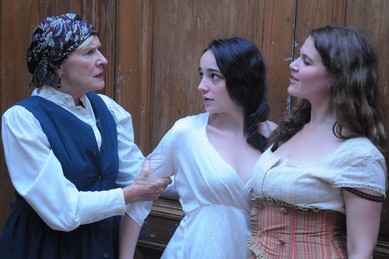
Photo Credit: Jill Usdan. Photo Caption (l-r): Joy Franz, Leanne Agmon and Molly Stoller in a scene from Marvell Rep's production of Sholem Asch's "God of Vengeance."
Reviewed by Beatrice Williams-Rude
“God of Vengeance,” which officially opened Sunday, Oct. 7, 2012 is the latest offering by the Marvell Rep in its once-banned (and burned) play series. This work is by Sholem Asch, who is better known for his historical novels than as a playwright. (“The Nazerene,” and “The Apostle,” are but two examples.) This translation is by Joseph c. Landis.
“God of Vengeance” is the tale of a Jewish brothel owner, Yankel, who condemns himself as a sinner, but who wants a good life for his “pure” daughter, and of his difficulties in dealing with the Deity. “Punish me, but not my innocent daughter,” he commands, cajoles and beseeches God.
Getting Rivkele safely married to a good Jewish man, preferably a scholar whom Yankel would happily support for life, is Yankel’s raison d’être. Never mind what Rivkele wants for herself. She’s virtually a prisoner of her parents in her father’s zeal to keep her “chaste.” She’s kept at home and denied friends, because the only ones with whom she might cross paths are the “girls” in her father’s “house.” The “pure” home is the top floor of the building, the lower floors house the brothel. No business is conducted on the upper floor, the home.
Sam Tsoutsouvas, who was brilliant as “Professor Bernhardi” in the Marvell’s revival of the Schnitzler work, is nothing short of magnificent as the driven, single-minded bully of a father (and husband). Joy Franz is excellent in the complex role of the wife/mother, who had been one of Yankel’s prostitutes.
While the direction by Lenny Leibowitz was excellent overall, it could have been more nuanced. There was too much shouting—although, to be sure, every word was heard and understood. And most important, the black comedy was fully exploited. This play has great humor but could be lost with a lesser director.
The play might well have influenced Edward Albee, whose “Everything in the Garden” touched on a similar situation and was awash in black humor. A theme of both works is money as a means for buying respectability and of keeping secret the means by which it was acquired.
The cast was splendid. Leanne Agmon, as the lovely Rivkele, was radiant, reminiscent of the young Audrey Hepburn in “Gigi” on Broadway. Jason Emanuel as Shloyme, the vicious pimp, offered as vile—and effective-- a portrait as ever seen. Beautiful Stacey Linnartz as Hindi, the sometimes wife-to-be of Shloyme, presented a multi-hued picture of an abused woman who could be cunning. Vivacious Elizabeth Stahmann was Manke, Rivkele’s love interest—this lesbian relationship was among the shocking aspects of the work that led to its being banned in New York in 1923. Attempts to suppress it began in 1906, after its first performance and it was banned in London although hugely successful in Paris and elsewhere on the Continent.
Rachel Claire as Reyzi was riotous in her attempts to cope, and Molly Stoller as Basha, a new prostitute from the country who would like return to her village in her newly acquired finery, was touching.
And key, the delightful performance of Joel Bernstein as the hilarious, pragmatic Reb Elye—in contrast to Thomas Benton’s pious scribe. “Truth, what truth?” Reb Elye keeps asking in frustration as Yankel presses the issue. All this Reb wants is for people to rejoice, get on with the arrangements, and to stop shooting themselves in the foot.
When Yankel becomes convinced that Rivkele is not, by his unbending standards, “chaste,” in his wrath he forgets “Vengeance is mine, sayeth the Lord” and assumes the role of avenger. He repudiates the marriage agreement he himself had negotiated--to the consternation of all involved--and washes his hands of the heretofore venerated Deity. He no longer has use for the Torah Scrolls that he had commissioned and that had figured so prominently in his attempt to placate God on behalf of his daughter.
In both “Professor Bernhardi” and “God of Vengeance” at the eleventh hour the protagonist snatches defeat from the jaws of victory. At the end, Professor Bernhardi was achieving his goals, but was no longer interested and walked away. At the end, despite setbacks (which were overcome) Yankel was getting what he wanted for his daughter—a Jewish scholar for a husband—and instead of embracing his good fortune, he consigns his unwilling daughter to his brothel because in his eyes she’s failed his chastity test and no longer deserves a decent life.
“God of Vengeance” will run through Oct. 28 at the TBG Theatre, 312 West 36th Street, Third Floor.
Click here for original link of review.
